Decide what the shelves are there to do
There is a particular frustration in making a shelf look beautiful and then discovering there is nowhere to put the book you are reading. The problem is usually the brief. An arrangement designed only for a photograph has no obligation to accommodate a charging cable, a borrowed novel or the bowl that catches the house keys. Before moving anything, write a short list of what genuinely belongs on these shelves. Separate regularly handled things from occasional references and purely decorative objects. You are deciding how the shelves will work, rather than deciding which objects deserve to stay in your home.
A living room bookcase might need three generous shelves for novels, one accessible spot for a speaker and a modest area for family ceramics. A dining room shelf has different priorities: glasses should be easy to lift out, serving pieces should not be trapped behind ornaments, and fragile objects need a position away from passing shoulders. If the necessary contents already exceed the available space, styling will not solve the shortage. Move some items to enclosed storage, reduce the collection on display, or accept a fuller, library-like appearance. Full shelves can be handsome when their organization is deliberate.
Read the bookcase before arranging its contents
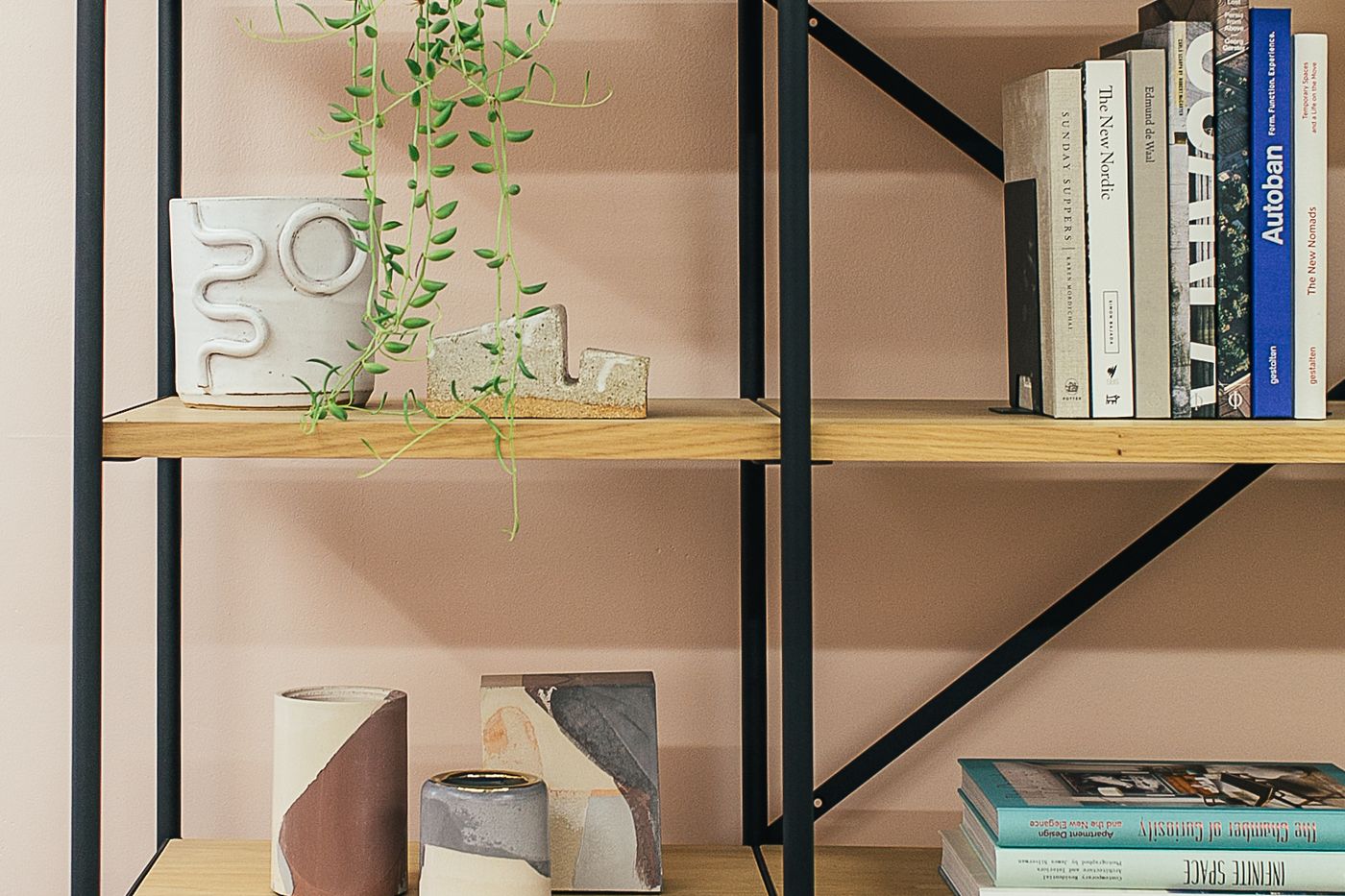
The frame is part of the composition. Thick dark uprights divide an arrangement into strong boxes, while fine pale shelving lets the contents create most of the rhythm. Adjustable shelves allow you to fit the openings to the collection; fixed shelves ask you to work within their proportions. Measure the height and depth of each opening before shopping for baskets or moving tall books. Check the manufacturer's loading guidance and distribute heavy contents accordingly. Tall furniture should be secured as its manufacturer directs, with suitable fixings for the actual wall. A visually balanced arrangement is not a substitute for secure installation.
Stand across the room and notice where the shelves sit in the wider view. A bookcase beside a busy patterned curtain may benefit from fewer colors. One at the end of a plain corridor can carry a richer collection. Consider the shadow at the back, too: deep shelving makes small objects disappear, especially against a dark finish. Rather than adding a lamp immediately, try bringing a few pieces forward while leaving enough depth to keep them stable. The best position is one that reveals the object and still lets you use the shelf without an awkward reach.
Give books a readable order
Books are easiest to live with when you can find them. Organize first by the system that matches your habits: subject, author, reading status or a broad division between fiction and reference. Within each group, you can moderate abrupt changes in height without abandoning that order. Keep a run of cookbooks together even if their spines refuse to match. A home library does not need to pretend it was purchased as a coordinated set. Removing dust jackets purely for color can also erase useful titles and damage the protection a book already has.
Most books are comfortable upright with appropriate support, rather than leaning in a chain that bends the first and last volumes. A short horizontal stack can fit an unusually broad format or support a small, lightweight object, but avoid towers you must dismantle to reach a favorite book. In a shelf opening roughly the width of two dining chairs, for example, place a substantial upright group on one side and a low stack near the other, with a little clear space between. The contrast comes from orientation and height. You do not need a different ornament in every remaining gap.
Use weight rather than rigid symmetry
Visual weight comes from more than size. A small black bowl can command as much attention as a larger clear glass vase, while a bright book spine may jump forward against a quiet background. When one end of a bookcase feels crowded, ask whether the problem is the number of objects or their combined contrast. Move the darkest piece before emptying the whole shelf. Sometimes a simple exchange between two levels brings the arrangement into balance. This is more useful than counting objects or following a rule that every group must contain an odd number.
Try distributing the strongest elements across different heights rather than stacking them in a vertical stripe. A dark ceramic vessel on an upper shelf might be answered by a cluster of dark book spines lower down, on the opposite side. That does not require a precise diagonal. It just prevents one part of the unit from carrying all the emphasis. Keep the lower shelves physically practical as well: heavy items generally belong low, where the shelf's load rating and access allow. Small fragile collectibles should not be placed low merely to complete a visual pattern, especially around children or pets.
Leave enough space to handle things
Empty space is useful before it is decorative. You need room to grasp a vase without scraping your knuckles, lift a book without disturbing a neighboring stack, and return a basket without compressing its sides. Test those movements while arranging. If an object can only be removed with two careful hands and a rearrangement of everything around it, it belongs in a display cabinet or a less active position. On shelves used daily, the ease of picking something up is a better measure than how neatly every edge aligns in a photograph.
You can leave one opening almost empty while allowing another to be densely filled. Repeating exactly the same amount of vacant space on every shelf often makes a bookcase look staged. A wide bowl on a quiet shelf gives the eye a rest; a neighboring row of books supplies texture. Think of the pauses in relation to the whole room. If the shelves contain the room's main collection of personal objects, they can be relatively full. If every surrounding surface is already occupied, a few larger pauses may give both the furniture and the room a clearer outline.
Introduce personal objects without making a collection compete
A useful object can also be a personal one. A hand-thrown jug, a stone picked up on a permitted walk, or a photograph in an inherited frame has a reason to be present beyond filling a gap. Choose a few pieces whose shapes read clearly at room distance. A collection of tiny objects is often more legible when gathered on a shallow tray or displayed together in one opening. Scattering them across every shelf can make each piece disappear while the bookcase as a whole feels fussy. Gathering is not hiding; it gives a small collection a boundary.
Photographs work best when their viewing angle is realistic. A small frame well above eye level may catch the ceiling instead of showing its image. Put it where you can actually see it, and do not prop unstable frames in front of books that are frequently removed. You can vary frame finishes if there is another relationship between them, such as similar scale or a shared dark outline. Keep sentimental importance separate from permanent display. Rotating a few photographs or keepsakes lets you enjoy them more closely without requiring every meaningful object to occupy the shelves at once.
Make baskets and boxes earn their place
Enclosed containers are helpful for contents that do not behave neatly: spare cables, game controllers, craft supplies and packets of photographs. Measure the usable opening, including the clearance needed to pull the container out. A basket that fits with no room around it may scrape the finish or require an awkward tug. Check whether a woven base will catch on the shelf and add an appropriate protective liner if necessary. Handles are useful when they are accessible from the front; side handles lose much of their value when another basket is pressed against them.
Choose containers by their contents before choosing a matching set. A low box makes small cables visible, while a deep basket suits soft throws better than loose stationery. Heavy objects in a deep basket can be difficult to lift and may strain both the basket and the shelf. Discreet labels help everyone return things to the right place, particularly on shared shelves. Two or three related containers can establish order without making every opening identical. Mixing one woven basket with a plain lidded box often feels more natural than installing a wall of identical containers that conceal unrelated, poorly sorted piles.
Keep maintenance inside the design
Dusting is much easier when an arrangement comes apart in a few simple groups. A tray of small objects can be lifted as one unit, while a crowded line of individual ornaments demands repeated handling. Keep open containers away from spots that receive cooking grease or heavy dust, and do not place vulnerable paper collections in persistent direct sunlight or damp conditions. Plants can soften shelving, but their light needs come first. Use a watertight outer pot or a suitable saucer, remove the plant for watering when practical, and never assume a decorative basket will protect the wood beneath it.
Build a small reset into ordinary use. Return stray papers to their actual destination rather than adding them behind a bowl. When a shelf begins to collect items that do not belong anywhere, treat that as information about missing storage. Perhaps the room needs a file box for current paperwork, or a basket near the door rather than another decorative vessel. Shelves stay calm when their arrangement responds to recurring behavior. They become frustrating when the only maintenance plan is to restore an elaborate photograph every weekend. A reasonable arrangement should survive being used by more than one person.
Finish from the doorway, then test at arm's reach
After making changes, leave the room and return through its usual entrance. That view reveals the broad rhythm more clearly than standing with your face close to one opening. Look for an isolated bright object that pulls too hard, a heavy cluster at one end, or a row whose tops form an accidental slope. Adjust one thing at a time. A phone photograph can help flatten the view, but it should support your judgment rather than become the final authority. Real shelves are experienced while walking, sitting and reaching, under changing light, not only through a single lens.
Now use the shelves. Take down the book you would normally reach for, retrieve the game, and return the bowl after dinner. If those actions disturb the arrangement, simplify the relevant area. The final result does not need to communicate a single perfectly controlled style. It should make the room feel inhabited by people with interests, while keeping those interests accessible. A few uneven book spines and an empty space waiting for the next volume are entirely compatible with a considered home. The arrangement is finished when it gives your possessions a useful place and leaves you free to stop arranging them.
Take it home
- Sort by actual use before arranging for color.
- Check shelf loading and secure tall furniture as directed.
- Test removing and returning everyday objects.
- Leave one clear space for the next book or useful addition.